
Cranesmuir The Real Scottish Village Behind Outlander

Updated: Oct 1
The television production needed a place that could make this fictional settlement convincing. It found one in Culross.
For fans of Outlander, certain places seem almost as important as the characters themselves. Castle Leoch, Lallybroch, Culloden and Craigh na Dun all form part of the world Claire enters after travelling through the stones. And then there is Cranesmuir.
The fictional eighteenth century village plays an important role in the early story of Claire and Jamie Fraser. The village seen on screen, however, is real: Culross, on the shore of the Firth of Forth in Fife. Visitors can walk its cobbled streets, stand at its Mercat Cross and see the buildings that helped bring Cranesmuir to life.

Culross Palace
Welcome to Cranesmuir
In Outlander, Cranesmuir lies near Castle Leoch. It is home to Geillis Duncan and her husband, the local procurator fiscal. Claire and Geillis become acquainted through their shared interest in herbs and healing, although Claire soon senses that Geillis knows more than she lets on.
As suspicion and accusations of witchcraft gather around them, the village becomes the setting for some of the first season’s most memorable scenes. The television production needed a place that could make this fictional settlement convincing. It found one in Culross.
When Culross Became Cranesmuir
Culross is Scotland's best example of a 17th-century village.Narrow lanes climb between old houses, while red pantile roofs and stone buildings frame the village square. Much of the setting needed little alteration for a period drama.
The filmmakers did make one striking change. Around the Mercat Cross, buildings normally painted white were temporarily given grey and brown tones. For viewers, those familiar streets became the darker world of Cranesmuir. After filming, the buildings returned to their usual colours, but the village remained instantly recognisable to Outlander fans.
The Mercat Cross
The Mercat Cross appears in Season 1, Episode 3, The Way Out. A young boy caught stealing has his ear pinned to a post and is left there as punishment. Horrified, Claire persuades Jamie to help. While she distracts the people nearby, Jamie frees the boy.
The scene shows a tension that runs through Claire’s story: she knows she has arrived in a different century, yet she cannot simply accept its cruelty. At the real Mercat Cross, the surrounding streets make it easy to picture the scene unfolding.
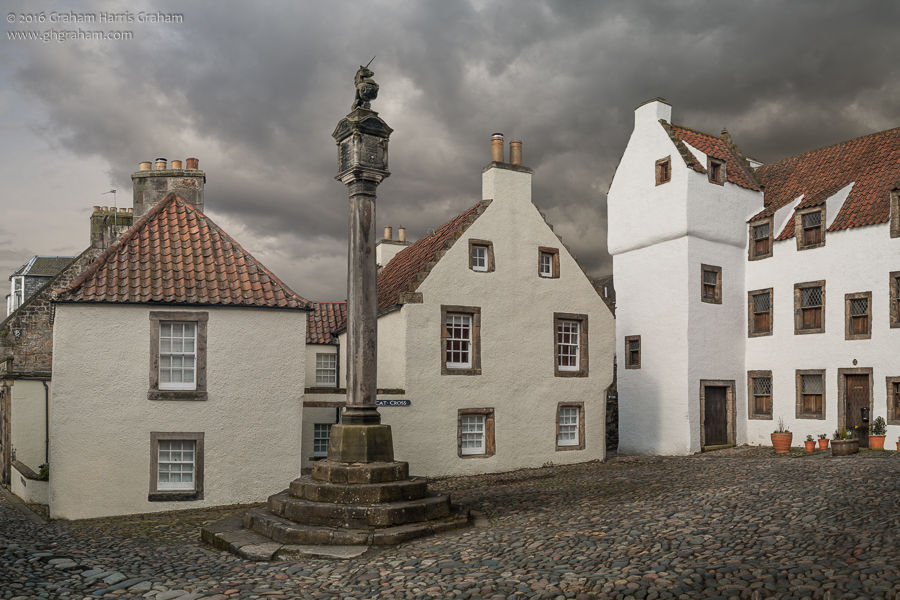
Mercat Cross
Beside the Mercat Cross stands The Study, the historic building used for the exterior of Geillis Duncan’s house. Inside Culross Palace, the Withdrawing Room became Geillis’s parlour. It is there that Jamie arrives while Geillis is pressing Claire with uncomfortable questions.
The production returned to The Study for Geillis’s house in Season 7. This continuity is a pleasure for visitors: the screen locations are real buildings, and they can still be seen in the village today.

Geillis House (The Study)
Claire Geillis and the Witch Trial
Cranesmuir is closely associated with the accusations of witchcraft against Claire, and Geillis. Their ordeal reaches a dramatic point in The Devil’s Mark, when Claire discovers the smallpox vaccination scar on Geillis’s arm. She realises that Geillis, too, has come from another time.
Culross supplies an important part of the story’s visible setting. The production used other Scottish locations for some court scenes: the preliminary hearing, for example, used a room at Preston Mill. The distinction matters when following the story from one filming place to another.
The Real Geillis Duncan
Geillis Duncan also has a connection to Scotland’s history beyond the series. A woman of that name was accused of witchcraft in 1590. Her forced confession became part of the accusations associated with the North Berwick witch trials. The historical woman lived more than a century and a half before Claire’s fictional visit to Cranesmuir, but her name gives the story a sobering echo of real events.
Culross Palace has also displayed a costume worn by Lotte Verbeek, who portrayed Geillis on screen, adding another link between the character and the place where her home was filmed.
The Garden That Became Castle Leoch
Culross played another Outlander role that is easy to miss. The garden behind Culross Palace became the herb garden at Castle Leoch in The Way Out. Claire gathers medicinal plants there, using knowledge that helps her find a place in the eighteenth century and draws her closer to Geillis.
The garden is a reminder that a single real location can stand in for several places in a fictional world. Visitors exploring Culross can find both Cranesmuir’s streets and a corner of Castle Leoch within a short walk.

From Fictional Village to Real Place
The pleasure of visiting Cranesmuir is discovering how much of it was already there. Culross did not need to be built as a set. Its lanes, cobbles, rooftops and old houses have survived long after the cameras left.
Stand at the Mercat Cross and imagine Claire crossing the square. Look towards The Study and picture Geillis at home. Wander up one of the narrow lanes and the present day can feel unexpectedly distant. Outlander may tell a fictional story, but here in Fife, the village behind Cranesmuir is waiting to be explored.

Townhouse Brae
Explore Graham Harris Graham’s photographs of Culross and
the real locations behind Cranesmuir.
Comments